


Lab-Created vs. Natural Diamonds: What You Need to Know
If you are weighing lab created diamonds vs natural stones, the first thing to settle is that the stone itself is not the mystery. Both are real diamonds with the same crystal structure, and both look the same to the naked eye. The harder questions are how each one formed, how its origin gets confirmed, and what you are really paying for once the setting, the metal, and the resale picture come into view. We hear these questions at our bench in New York every week, so this guide answers them with facts rather than sales language.
Table of Contents
- Quick Takeaways
- Are Lab Diamonds Real?
- How Each Diamond Is Formed
- How Gemologists Tell Them Apart
- Price, Size, and Resale Value
- Lab Diamond Engagement Rings
- Lab Diamond Jewelry Beyond the Engagement Ring
- Lab-Created vs. Natural: Side by Side
- Frequently Asked Questions
- References
Quick Takeaways
| Key Insight | Explanation |
|---|---|
| Lab-created diamonds are real diamonds | GIA describes laboratory-grown diamonds as having essentially the same chemical composition and crystal structure as natural diamonds, so the word "fake" does not apply. |
| Looks alone cannot settle origin | Both types look the same to the unaided eye, so ask for a grading report that states the origin in writing. |
| Trust the report, not the sales page | Origin is confirmed with laboratory testing of inclusions, graining, and reactions to UV light, not with a visual check. |
| Price is the main reason buyers switch | Lab-grown stones typically cost well below mined stones of comparable grade, which can move you up in carat weight or quality. |
| Resale is the weak point of both | Expect a diamond to resell for much less than you paid, so buy it to wear rather than to invest. |
| The setting decides how the stone lasts | Prong thickness, metal quality, and head design matter as much as the origin of the stone. Our rings are set in solid 14k gold for this reason. |
Are Lab Diamonds Real?
Yes, lab diamonds are real diamonds. The Gemological Institute of America (GIA) describes laboratory-grown diamonds as having essentially the same chemical composition and crystal structure as diamonds created by nature. The terms "synthetic," "created," and "man-made" describe how the stone was made, not whether it is a diamond.

The confusion usually comes from the word "fake." A fake is a simulant such as cubic zirconia or moissanite, which imitates a diamond's look using a different material. A lab-grown diamond is carbon arranged into the same crystal structure as a mined stone, which is why we set them with the same care we give mined stones.
A useful comparison is ice. Ice that forms outside on a winter day and ice that forms in your freezer are both ice, even though their origins differ. GIA uses a similar comparison, and it holds up in practice. The origin changes the story, not the material.
The origin of a diamond tells you where it was made. It does not change what the diamond is.
Where the two actually diverge is in how they form, how long that takes, and what they cost. Natural diamonds formed deep in the earth over geological time. Lab-grown stones can be produced in a matter of weeks, and that difference in production is the main reason their prices sit lower. Always ask for a grading report that states the origin, and if a seller cannot show one, treat that as a warning sign.
How Each Diamond Is Formed
Natural diamonds form in the mantle under high pressure and heat, over billions of years. Volcanic activity eventually carries some of those stones toward the surface. Lab-grown diamonds skip the geology and reproduce the carbon crystal structure in a controlled environment. Two methods dominate gem production, and both yield stones that are chemically the same as mined diamonds.
The HPHT growth method
HPHT stands for high-pressure, high-temperature, and it copies the conditions under which natural diamonds grow. A diamond seed goes into a chamber with carbon and a metal catalyst. According to GIA, the assembly is compressed and heated to temperatures between 1300°C and 1600°C and pressures of 5 to 6 GPa. The method usually produces colorless crystals, although it can also grow colored diamonds.
HPHT growth leaves its own evidence inside the stone, which is one reason identification requires a lab rather than a loupe and a hunch.
The CVD growth method
Chemical vapor deposition, or CVD, works differently. Carbon-containing gas is energized, and carbon builds up on a seed one layer at a time. According to GIA, CVD requires less heat and pressure than HPHT to form a diamond. CVD can produce colorless stones as well, and some stones undergo post-growth treatment, so ask whether yours has been treated.
Pro tip: Ask which growth method produced the stone and whether it received any treatment after growth. A grading report answers both questions far better than a product description does.
How Gemologists Tell Them Apart
Lab-grown and natural diamonds share the same composition, so identification depends on the traces that growth leaves behind. When a diamond is submitted to GIA, the lab examines its inclusions, graining, and reactions to ultraviolet light to determine whether it is natural or laboratory-grown. That takes specialized instruments and trained eyes, not a visual test you can run at home.
What lab testing examines
Inclusions are the tiny internal features inside a stone, and they often form differently depending on origin. Graining refers to growth patterns visible under magnification. Fluorescence, the way a stone responds under UV light, is another clue. A report that addresses these points gives you a verifiable answer rather than an opinion from a showroom floor.
Why the naked eye and basic tools fall short
A jeweler without specialized equipment can admire a beautiful stone and still have no idea where it came from. That is why we never rely on appearance alone. Before you pay for any diamond, match the report number against the grading lab's own records. Our IGI certified studs work the same way, since the certificate ties the stone to a specific record you can check.
Price, Size, and Resale Value
Price is where most buyers begin, and it is the biggest reason lab-grown stones have grown in popularity. Because production and supply chains differ, lab-grown diamonds typically cost far less than mined stones of comparable grade. For many budgets, that gap changes the question from "Can I afford a diamond?" to "What size and quality do I want?"

Why lab-grown stones cost less
Mined diamonds carry the costs of exploration, extraction, and long supply chains. Lab-grown stones are produced in controlled facilities, which tends to reduce those costs. The price difference is real, but it does not mean the lab stone is lesser. Price tracks production economics, not the chemistry of the stone.
How to spend the difference
The savings are most useful when you put them into what you will see every day. A stone with a larger carat weight, a higher color grade, or a cut that handles light well will usually impress more than a slightly bigger stone with weak cut quality. Set your ceiling first, then ask what it buys in lab-grown and mined terms. A common mistake is paying for a size you do not wear comfortably.
Resale value is the weak point
Be direct about this: lab-grown diamonds generally resell for far less than their purchase price, and the resale market for mined stones is weaker than many sellers suggest. Neither type should be treated as a savings plan. Buy a diamond you intend to wear, insure it properly, and treat resale as an unlikely bonus.
Pro tip: Decide whether you want the largest stone you can afford or the most finished piece at a lower carat weight before you shop. Those goals lead to different stones, and a jeweler can show you both options side by side.
Lab Diamond Engagement Rings
Lab diamond engagement rings are among the most common requests we handle, and they work well when the design is built around the stone. The main decisions are the center stone size, the setting style, and the metal. Get those right and a lab stone looks as solid on the hand as a mined one, which is the real test.
Choosing a setting for a lab center stone
Prongs matter more than most buyers expect. Four or six prongs hold a round stone securely, while a bezel setting offers more protection for someone who works with their hands. Thin prongs look delicate but wear down, so ask for prong thickness to be checked at fitting. The setting should suit the shape of the stone, not the other way around.
Custom engagement rings and wedding bands
We make solid 14k gold engagement rings and custom engagement rings in-house in New York. Because we handle design and manufacturing ourselves, we can adjust head height, band width, and stone placement before the ring is cast, rather than after it arrives. Custom wedding bands can be made to sit flush against the engagement ring, which matters for everyday comfort.
Ask your jeweler how the stone is secured at the back of the setting and whether the metal is solid gold throughout the band. Solid 14k gold holds up better than plated alternatives over years of wear. You can explore our engagement ring collection to compare designs.
Lab Diamond Jewelry Beyond the Engagement Ring
Lab diamonds are not only for engagement rings. Many of our customers buy diamond stud earrings, tennis bracelets, and solitaire pendants for everyday wear, anniversaries, and gifts. The same origin questions apply, but the purchase usually hinges on comfort, wearability, and how the piece works with clothes you already own.
Diamond studs and tennis bracelets
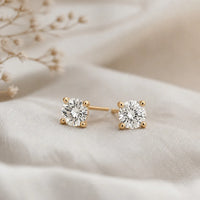
Diamond stud earrings are the easiest entry point for a lab stone. The pair is visible, comfortable, and easy to wear from the office to dinner. IGI certified studs add a grading document you can verify for buyers who want a paper trail. Tennis bracelets are different because they are worn constantly, so the clasp, the link construction, and the solid gold setting matter more than any single stone.
Pendants, gifts, and men's jewellery
Solitaire pendants and solitaire necklaces suit gift giving because a single well-cut stone reads as deliberate without being showy. Men's jewellery is another area where lab diamonds stretch a budget, for example in a band with a small diamond accent. Day to night pieces and wardrobe staples follow the same logic: the piece should suit how the person actually dresses.
Gift buyers often overlook sizing. For a pendant or necklace, check the chain length against the neckline the recipient usually wears, because a 16-inch chain and an 18-inch chain look very different on the same person.
Lab-Created vs. Natural: Side by Side
Once you have weighed origin, identification, and price, a side-by-side view helps. The table below compares lab-created and natural stones on the factors that tend to decide the purchase. Use it as a checklist rather than a verdict, since your budget, timeline, and priorities will tip the balance.

| Factor | Lab-Created (HPHT or CVD) | Natural (Mined) |
|---|---|---|
| Formation | Grown in a lab over weeks using HPHT or CVD | Formed in the earth over billions of years |
| Identification | Requires lab testing of inclusions, graining, and UV reactions | Requires the same lab testing, since origin cannot be seen by eye |
| Typical price | Usually well below mined stones of comparable grade | Higher, reflecting extraction and supply costs |
| Resale value | Generally low | Also generally low, though it tends to hold somewhat more value |
| Best fit | Larger stone or wider budget for everyday wear | Buyers who prioritize a traditional origin |
If size and budget are your priorities, lab-created stones give you the most for your money. If a mined origin matters to you for personal or family reasons, that is a valid choice, and we will help you find a well-cut stone either way. The wrong choice is buying a stone whose origin you never confirmed.
Frequently Asked Questions
Are lab created diamonds vs natural stones different in sparkle?
Not in the way most people mean. Both are diamond, so sparkle depends mainly on cut, proportions, and polish. A well-cut lab stone and a well-cut mined stone of the same grade will look equally bright.
Are lab diamonds real?
Yes. GIA describes laboratory-grown diamonds as having essentially the same chemical composition and crystal structure as natural diamonds. The difference lies in how they formed, not in what they are.
Can a jeweler tell the difference without testing?
Usually not. Both types look the same to the unaided eye, so origin is confirmed through laboratory testing of features such as inclusions, graining, and UV reactions.
Do lab-grown diamonds hold their value?
Generally not on the resale market. Treat any diamond as a purchase for wearing, and keep the grading report so the stone can be identified later.
Is a lab diamond engagement ring a good choice?
It is a strong choice if you want a larger or higher-quality center stone for your budget and you plan to wear the ring every day. Choose the setting with the same care you would give a mined stone, because the mounting determines how well the stone lasts.
Tell us in the comments which stone you chose and what made the decision easier, because your experience helps other buyers weighing the same question.
References
- Choosing a selection results in a full page refresh.
- Opens in a new window.