


Family Owned Jewelry Brand: Why Eternity Is Different
Plenty of jewelry brands call themselves a family owned jewelry brand, and most shoppers have no way to check what that label means once the box is opened. Family ownership is only worth something if the family still makes decisions about the metal, the stones, and the finished piece. At Eternity Wedding Bands, we are a third-generation, family-owned manufacturer based in New York, and we design and produce everything in-house. This article explains what that setup changes for engagement ring shoppers, bridal couples, and anyone buying everyday fine jewelry, and where the claim stops being useful.
Table of Contents
- Quick Takeaways
- What Family Ownership Actually Changes
- Why Third Generation Means Something Specific
- Designing and Producing In-House
- Honest Pricing Without the Retail Markup
- Solid 14k Gold and Lab Created Diamonds
- Custom Work and the Family Workshop
- How Buying Options Compare
- Lifetime Care and Repairs
- Frequently Asked Questions
- References
Quick Takeaways
| Key Insight | Explanation |
|---|---|
| Ownership shows up in the workshop | Family ownership matters when the people who approve a casting are the same people who answer your questions after delivery. |
| Ask who actually makes the piece | A real manufacturer can describe its own casting, setting, and polishing steps. A reseller usually cannot. |
| Solid 14k gold is the everyday baseline | Look for a solid gold stamp on the piece itself, not plating or vague "gold tone" language. |
| Lab created diamonds shift the budget | Lab created stones typically cost less than mined stones of similar size and grade, which leaves more room for setting quality and design. |
| Markup is the hidden line item | Without a showroom markup layer, compare the cost of metal, stones, and labor directly rather than accepting one total price. |
| Custom work needs a written brief | Bring finger measurements, a width or profile preference, and a budget ceiling before the first sketch is drawn. |
| Care should be part of the purchase | Ask how resizing, prong checks, and repairs are handled before you buy, not after a stone loosens. |
What Family Ownership Actually Changes
Family ownership is easy to claim and hard to test from a product page. A useful working definition is a business where the founding family keeps real operational control across more than one generation, rather than a brand name licensed to a larger group. The difference shows up in how decisions get made when something goes wrong, which is far more often than most shoppers expect.

Who makes the decisions when something goes wrong
A setting may sit slightly crooked, or a ring may arrive a half size off from what was ordered. In a multi-brand retail chain, that problem often gets routed through a customer service queue, a supplier, and a return policy. In a family business, the answer usually comes from the person whose name is on the workshop door, and that person has a direct stake in the result.
We see this most often with bridal orders, where the stone has been chosen, the date is fixed, and there is no time for a second attempt. A family manufacturer can decide on the spot whether a piece is re-set, re-cast, or rejected. That speed comes from having the production team and the owners in the same conversation.
Why relationships outlast a single sale
Many of our customers come back years later for an anniversary band, a gift for a daughter, or a resize that was not needed at the time of purchase. Trade coverage of family-owned fine jewelry brands keeps returning to trust, craftsmanship, and long-term relationships as the real basis of loyalty. Those relationships only hold if the people who made the piece are still reachable.
A jewelry brand earns its reputation one repair ticket at a time, and the family that signs the ticket is the one that remembers how it turned out.
Pro tip: Before you buy, ask who you would contact in two years if a prong loosened. The answer tells you more about a brand than any heritage story on the homepage.
Why Third Generation Means Something Specific
"Third generation" is a marketing phrase unless it changes how the work gets done. In our case, the phrase describes a workshop that has been passed down, adjusted, and kept accountable across three generations, and we have been in business for 22 years. The practical result is a set of habits that were learned on the bench rather than written into a manual.
What a third generation inherits
What gets inherited is less the equipment and more the judgment: how to assess a setting by eye, when to reject a stone that technically passes a checklist, and what a clean finished edge should look like. Those standards are difficult to document completely, which is why they tend to disappear when production moves to a rotating pool of outside suppliers. Keeping them inside one family is a deliberate choice, not an accident.
In practice, this shows up in small places. A prong is shaped to hold a stone without pinching it, and a tennis bracelet link is checked for smooth movement before it leaves the bench. None of these details appear on a spec sheet, but they are the reason a piece still looks right after ten years of daily wear.
Continuity versus reinvention
Each generation updates the designs while keeping the construction standards. We now offer over 450 designs, and the newer pieces use the same casting and finishing routines as the older ones. A modern silhouette on a proven structure is more useful to a customer than a trend that is built to last one season.
The trade-off is that a family business can feel slow to change. We accept that. A bridal piece that will be worn every day for decades should not be treated as an experiment, and we would rather refine a proven construction than chase a look that does not hold up.
Designing and Producing In-House
Most jewelry sold online passes through several hands before it reaches the customer, and each handoff is a chance for specifications to drift. In-house production means design, modelling, casting, setting, polishing, and final inspection happen under one roof. That single chain is the main reason we can say with confidence what goes into each piece.

From sketch to wax model
A design usually begins as a sketch or a digital file, then moves into a model that can be checked for proportion, weight, and wearability. From there, the model is cast in metal and sent to the setting bench. Each stage gives the next one a chance to catch a problem early, which is cheaper than fixing it after a stone is already set.
We use modern digital tools alongside hand finishing. The digital side helps us check dimensions and repeat a design accurately. The hand side decides whether the edge feels comfortable against the skin, which no file can judge on its own.
Where precision metal manufacturing fits
Precision metal jewelry manufacturing matters most in the smallest parts: the prongs that hold a stone, the bails on a pendant, the hinges and clasps on a bracelet, and the posts and backs on a stud. A difference of a few tenths of a millimeter can decide whether a stone sits level or rocks under light pressure. Those parts carry the load, so they get the most attention.
Pro tip: Ask whether the maker can describe its own casting and setting steps in plain language. Vague answers often mean the piece was assembled from parts bought elsewhere, which makes quality harder to trace.
Honest Pricing Without the Retail Markup
"Honest pricing" appears on almost every jewelry website, so it deserves a concrete definition. For us, it means no showroom rent built into every piece, and a cost structure you can compare line by line. Our aim is accessible luxury, which means the price should reflect the metal, the stones, and the labor, rather than the address of the store.
Where the retail markup usually hides
A traditional showroom price has to cover the building, the sales floor, the staff who spend time with each customer, and the inventory that may not sell for months. Those costs are real, and some shoppers are happy to pay for in-person service. Other buyers would rather have that money go into the metal and the stone, and that is the group we build for.
Because the markup is not visible on a price tag, it is easy to miss. A useful habit is to ask any seller how the price is split between materials and labor. A brand that can answer clearly usually has nothing to hide.
How to compare two quotes fairly
Compare like with like: the same metal and karat, the same stone size and grade, and the same certification. A quote that is far below the others is often using plating instead of solid gold, or a smaller stone than the listing suggests. Price alone tells you very little until the specifications match.
Once the specs match, look at the total, then ask what is included. Resizing, a warranty on setting work, and cleaning after delivery are all things that can change the real cost of ownership over a decade.
Solid 14k Gold and Lab Created Diamonds
Our pieces are set in solid 14k gold with brilliant lab created diamonds, and IGI certified studs are also available. These choices were made for daily wear, not for a single photograph. Gold purity and stone origin are the two details most worth understanding before any purchase.
Why solid 14k gold is the everyday standard
Fourteen karat gold is an alloy with a higher share of other metals than 18k or 24k, which makes it harder and more resistant to scratching and bending. That matters for prongs and settings, which take daily knocks from keyboards, car doors, and bathroom sinks. Higher karats look richer in color, but they are softer and more prone to wear.
When you shop, look for a solid gold mark on the piece itself. Plated or gold-filled items may look similar at first, but the finish wears through, and the base metal underneath is not the same material.
Lab created diamonds and what to check
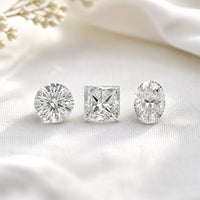
Lab created diamonds have the same chemical and optical properties as mined diamonds, and they usually cost less at a given size and grade. Our practical advice is to spend the difference where it shows: a secure setting, a well-proportioned band, and a finish that holds up. Size and cut affect appearance more than most shoppers expect.
Check the cut, color, clarity, and carat weight as listed, and ask for the grading information in writing. A stone with strong brilliance and clean finish usually outperforms a larger stone that looks dull.
IGI certified studs
Diamond stud earrings are one of the easiest pieces to verify, because they are small, symmetrical, and bought in pairs. An IGI grading report links a specific pair to measured characteristics, so you can match the report to the stones you receive. Ask for the report number at purchase and keep the documentation with the box.
Pro tip: For studs, confirm that both earrings are listed with matching grades. Mismatched pairs are rare, but a written spec makes any discrepancy easy to raise early.
Custom Work and the Family Workshop
Custom wedding bands and custom engagement rings are where family manufacturing shows most clearly. A custom order runs through the same bench, the same people, and the same quality checks as a catalogue piece. The difference is that the brief comes from you, so the quality of that brief decides much of the result.
If you are looking for a custom piece through our site, you can start at Eternity Wedding Bands and share your preferences directly with our team.

Custom wedding bands
Bring a width, a profile, a finish, and a decision on whether you want stones. If the band needs to sit flush against an existing engagement ring, measure that ring's profile rather than guessing from memory. A few millimeters of difference in height can cause the two pieces to rub or separate.
We also ask about daily activities. A band worn during manual work needs a different profile and finish than one worn only for formal occasions, and that answer changes the recommendation.
Custom engagement rings
Start with the setting style, the stone, and how you wear your hands. Someone who types all day usually needs a lower profile than someone who gardens or climbs. We recommend deciding on the stone shape before the setting, because the shape limits which prong layouts and head styles will protect it properly.
Pro tip: Send a photo of the existing ring from the side, along with a finger size taken at the end of the day when your hands are at their normal size.
How Buying Options Compare
Shoppers usually choose between three routes: a family-owned manufacturer that sells directly, a traditional showroom, or a marketplace listing. Each route has real strengths, and the right choice depends on what you value most. The table below compares them on the points that matter most for a long-term purchase.
| Buying Route | What You Typically Get | Main Trade-Off |
|---|---|---|
| Family-owned in-house manufacturer | Direct control over design, metal, and finishing, plus pricing without showroom overhead | Brand recognition is smaller than a national name, so you need to verify the process yourself |
| Traditional showroom jeweler | In-person viewing, a local repair relationship, and time with a salesperson | Overhead is built into the price, and sourcing details are often less transparent |
| Marketplace or reseller listing | Wide selection and easy price comparison across many sellers | The maker is often unknown, and quality depends heavily on the listing description |
No single route wins every purchase. A showroom suits a buyer who wants to try on a dozen rings in one afternoon. A marketplace suits someone who already knows exactly what they want. For a custom or heirloom-quality piece, a manufacturer that can explain every step of production usually gives you the most accountability per dollar.
Lifetime Care and Repairs
Our business description promises a lifetime of care, and that promise only means something if it is specific. Care covers cleaning, prong checks, resizing, and replacing a stone that has been lost. Ask any jeweler what happens in year three, not just on the day of delivery.
What routine care looks like
Most pieces need a simple routine: gentle cleaning with warm water and mild soap, a soft brush for the setting, and a check for loose prongs every few months. Daily wear is hardest on rings and bracelets, so those deserve the most attention. Store pieces separately so they do not scratch each other.
A regular check is cheaper than a repair. A prong that is caught early can usually be tightened in minutes, while one that is ignored can lead to a lost stone.
When to bring a piece back
Bring a piece in if you notice a stone that rocks, a clasp that does not close firmly, or a band that has become thin on one side. Resizing a ring is also much easier when the original workshop still has the model and specifications on file. That is one practical advantage of working with a manufacturer that keeps its own records.
Before any repair, ask for a written estimate. A reputable maker should explain what needs to be done, why, and what it will cost.
Frequently Asked Questions
What does family owned mean for a jewelry brand?
It usually means the founding family keeps meaningful operational control across more than one generation. For a manufacturer, that often translates into the same people approving designs, overseeing production, and answering customer questions.
How can I tell if a jewelry brand actually makes its own pieces?
Ask the seller to describe the casting, setting, and finishing steps and where each happens. A maker that manufactures in-house can usually answer in specific terms, while a reseller tends to give general answers.
Is solid 14k gold a good choice for everyday wear?
For most people, yes. Fourteen karat gold is harder than higher karats, which makes it more practical for rings and bracelets that see daily use. Check for a solid gold mark on the piece rather than relying on a color description.
Are lab created diamonds a good value for engagement rings?
They often are, because they usually cost less than mined diamonds of similar size and grade. The savings are most useful when they go into a secure setting and a well-finished band, since those details affect how the ring wears over time.
Can a family-owned manufacturer make custom wedding bands?
Yes, a manufacturer with its own bench can design and produce custom bands. The best results come from a clear brief that includes width, profile, finish, and how the band will be worn each day.
What should I check before buying an IGI certified stud?
Ask for the report number, confirm that both earrings are listed with matching grades, and keep the documentation with the box. These steps make it easy to verify what you received against what was promised.
Have you bought from a family-owned jewelry maker before, and what made you trust it or walk away? Share your experience in the comments, because your story may help another couple choose more carefully.
References
- Choosing a selection results in a full page refresh.
- Opens in a new window.